



The Hidden Impact of Lounge Furniture on Comfort, Focus, and Wellbeing
How seating shapes how people feel once they are seated
If Part 1 is about behaviour, this part is about experience. Once someone is seated, furniture continues to influence how they feel, how they focus, and how they interpret the environment around them.
These effects are less visible, but they are just as important in shaping whether a space feels comfortable, productive, or calming.

Posture influences activity
The geometry of seating plays a direct role in what people do while seated. Ergonomic research consistently shows that posture influences functional behaviour, with different seating positions supporting different types of activity.[4]
Upright seating supports focused work and conversation. Reclined seating encourages relaxation and passive waiting. Perch seating is suited to short interactions, and lower lounge seating supports informal social engagement.
When posture and intended activity are misaligned, users feel it quickly, even if they cannot articulate why.
Soft seating contributes to acoustic comfort
Lounge furniture plays a meaningful role in the acoustic performance of a space. Upholstered surfaces help absorb sound and reduce ambient noise in busy environments.[9][10]
This creates more usable acoustic conditions by reducing speech spillover, softening background noise, and creating quieter micro-zones within open layouts.
In open environments where noise control is often a challenge, seating becomes part of the acoustic system whether it is intentionally designed that way or not.
Form and material influence emotional response
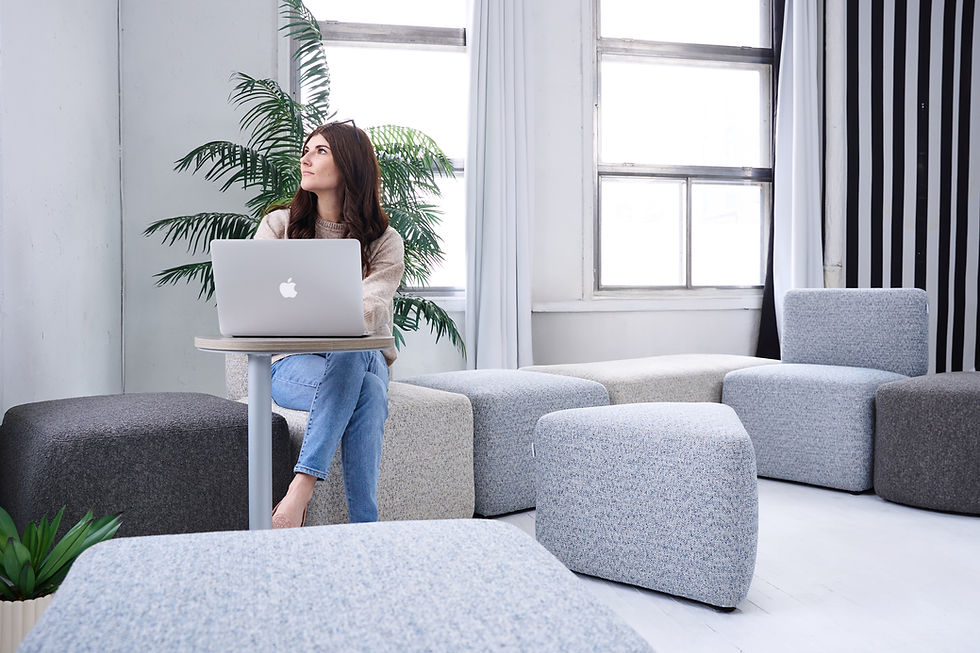
Before anyone physically interacts with seating, they are already responding to it visually. Shape and material communicate tone, and research shows that people tend to associate curved forms with comfort and safety, while angular forms feel more structured or formal.[13][14]
These impressions form quickly and often subconsciously. Rounded forms feel approachable, soft textiles suggest comfort, and neutral palettes create calm. In contrast, sharper geometry and high-contrast finishes introduce energy or formality.
These cues shape how a space is interpreted long before it is used.

Cleanliness affects willingness to engage
Perception of cleanliness plays a direct role in whether people choose to use seating in high-traffic environments. Users quickly assess whether furniture appears well maintained, easy to clean, and visually hygienic.
Material selection, seam detailing, colour choices, and overall condition all influence this perception. Even well-designed seating can be bypassed if it appears difficult to maintain or visually worn.
Closing thought
Comfort is not only physical. It is sensory, emotional, and perceptual. The best lounge seating supports more than posture or function; it creates an environment that feels coherent and intentional.
When posture, acoustics, materiality, and perception align, seating becomes less about the object itself and more about how the space is experienced.
___________________________________________________________________________________
References
[4] IJFMR (2025). Ergonomics in commercial seating systems.
[9] Persy Booths (2026). Does Furniture Absorb Sound?
[10] Persy Booths (2026). Open-plan acoustic reduction study.
[13] Psychological Science study (cited in House of Leon, 2024).
[14] Oregon State University. Curvilinear vs rectilinear emotional response study.


It's fascinating how many layers contribute to true comfort beyond just the physical support of a seat. The point about curved forms feeling more comforting and safe compared to angular ones is particularly insightful, highlighting how visual cues shape our subconscious interpretation of a space. This intricate interplay of design elements reminds me of how complex structures can be built from simple components, much like in infinite craft, underscoring the importance of intentional design in creating environments that genuinely work for people.